
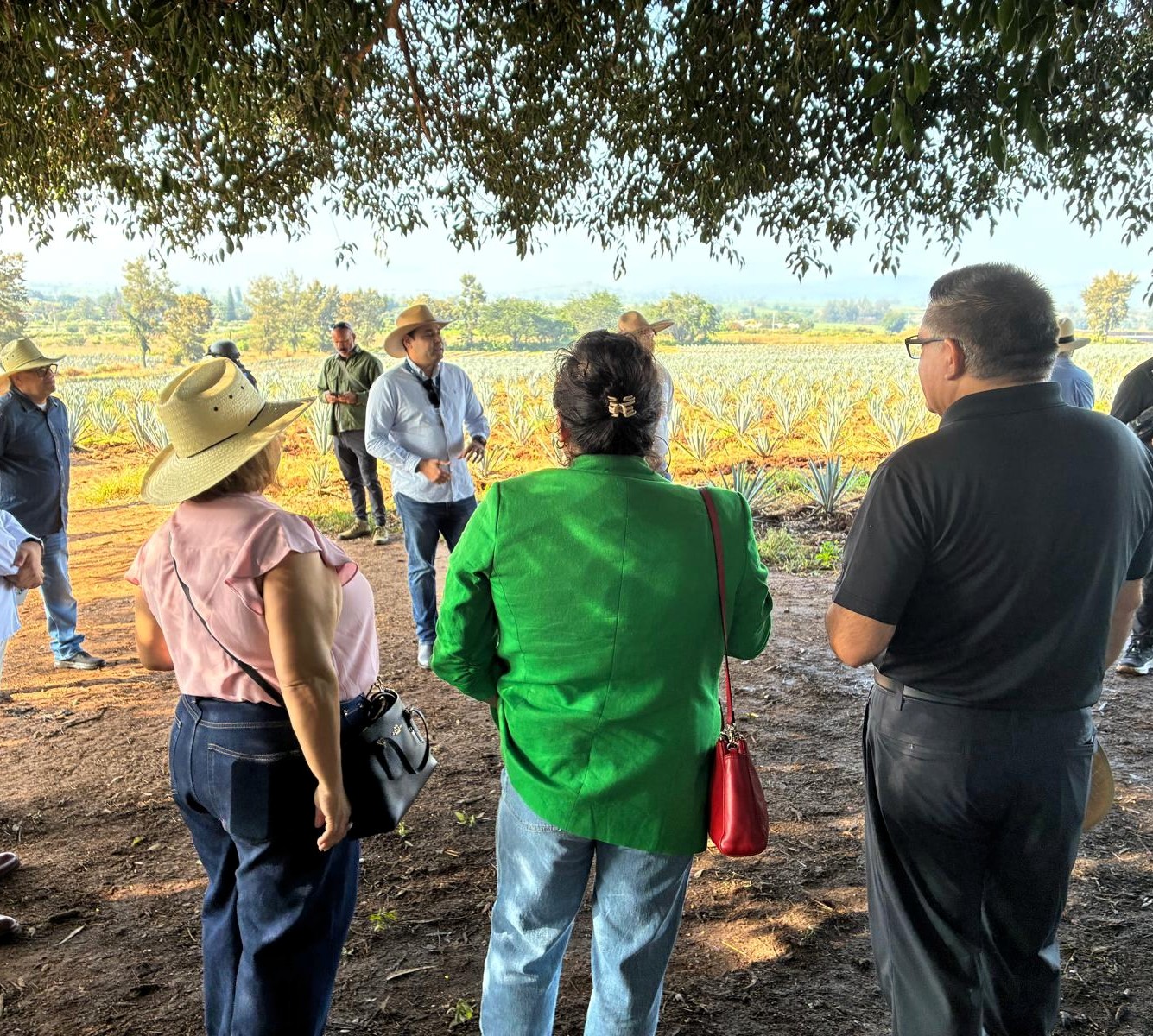
Zapopan, Jalisco.- A delegation of United States members of Congress conducted an official visit to the state of Jalisco to meet with local agribusiness leaders and state officials. The summit aimed to consolidate the bilateral commercial agenda and safeguard the technical, tax, and designation-of-origin protections governing tequila sales in the North American market.
The delegation included U.S. Representatives Salud Carbajal, Linda T. Sánchez, and Emily Randall, members of the bipartisan Congressional Tequila Caucus—a legislative group dedicated to advancing the economic and cultural ties tied to the spirit. Their itinerary featured technical inspections at certification facilities, high-level political meetings, and tours of processing plants.
During a working session at the Tequila Regulatory Council (CRT) headquarters, representatives of the agave-tequila supply chain presented a strategic roadmap focused on seven pillars of bilateral cooperation. Priority requests included preserving tequila’s duty-free access and its recognition as a distinctive product under the United States-Mexico-Canada Agreement (USMCA), maintaining the bilateral Memorandum of Understanding on tequila trade, and strengthening technical collaboration between the CRT laboratories and the U.S. Alcohol and Tobacco Tax and Trade Bureau (TTB).
Additionally, the tequila sector called for enforcing the Certificate of Authenticity for Tequila Exports (CAETI) and coordinating joint legal actions against unauthorized global brands misusing the Tequila Designation of Origin. “Consider us a technical, transparent, and permanent ally. Our doors are open, our data is available, and our commitment is to work constructively with authorities, the industry, and the U.S. Congress to preserve the integrity of Tequila and consumer trust,” stated CRT President Aurelio López Rocha.
Representative Linda T. Sánchez emphasized the broader trade and fiscal landscape during her remarks. “My work currently focuses on tariffs, free trade agreements, taxes—all the fiscal matters that are important to the U.S. economy and foreign relations,” she noted, highlighting the delegation’s goal to strengthen cross-border value chains.
In macroeconomic terms, official industry figures underscore the dominance of the U.S. market for Jalisco’s agribusiness. Between January and August 2026, total tequila production reached 402.5 million liters, with exports accounting for 288 million liters. Of that exported volume, the United States absorbed 232.9 million liters—representing 81.02% of all international shipments.
Furthermore, the spirit’s economic footprint in the United States generates over $1.4 billion annually in federal and state tax revenue while supporting more than 200,000 direct and indirect jobs across distribution, manufacturing, retail, and hospitality sectors.
As part of their official tour, the legislative delegation held a private meeting with Jalisco Governor Pablo Lemus Navarro and members of his economic cabinet. The agenda concluded with talks alongside U.S. Consul General in Guadalajara Elizabeth Hoffman Franolich, President of the National Chamber of the Tequila Industry (CNIT) Roberto Ciprés Cruces, and representatives from the Distilled Spirits Council of the United States (DISCUS).